



Filtrer par
2 résultats
Exporter les résultats sélectionnés
Sélectionner tous les résultats de la page
-
Notice détaillée
Titre :
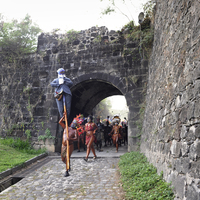
Fort Delgrès, Basse Terre
Auteur :
Lo Calzo, Nicola (1979-....)Lieu de la prise de vue :
Basse-Terre
Extrait de :
Cham, la mémoire vivante
Type :
Photographie - Couleur
Description :
The passing of the «Charge» at Fort Delgrès, Voukoum Group. The passing of the “charge” at the Fort Delgrès marks the ending of the «Mardi Gras» day, loading it with a very strong symbolic value: the Fort Delgrès is a French fort that dominates the city of Basse-Terre in Guadeloupe. It was a hotbed of Guadeloupe’s people fight against slavery, led by the resistant officer Louis Delgrès. After Napoleon re-established slavery in 1802 (after a first abolition in 1794 by Victor Hugues), Delgrès and Ignace’s rebellious colonial army occupied the fort. They abandonned it on May 22nd 1802 and took refuge at the foot of the Soufrière volcano, in Matouba. On may 28th 1802, as he saw himself lost, Delgrès and his 300 companions committed suicide with explosives, following the revolutionary motto: “to live free or to die”.
Conditions d'utilisation :
CC-BY-NC-ND - Attribution - Pas d'utilisation commerciale - Pas de modification
Provenance :


-
Notice détaillée
Titre :
Skull of an anonymous person, slaves cemetery of Sainte-Marguerite Bay In 1995, two cyclones furrowed the beach of the bay of Sainte-Marguerite, in the municipality of the Moule, in rapid succession.
Auteur :
Lo Calzo, Nicola (1979-....)Lieu de la prise de vue :
Le Moule
Extrait de :
Cham, la mémoire vivante
Type :
Photographie - Couleur
Description :
This is a very well liked picnic place for the inhabitants. In their fury, the sea and the wind uncovered many human bones, which no one expected. The following year, a team of archeologists exhumed dozens of new graves, dating from the 18th and 19th centuries. “The morphology of the skulls presented characteristics of black African populations. Some individuals had their teeth cut to a sharp point, a mutilation some people of this continent were practicing”, explains Patrice Courtaud (UMR 5199 CNRS- Anthropology unit), who led the excavations. A whole slave cemetery had been revealed from nothingness. This very rare skull, belonging to grave S225, had dental mutilations, a very rare proof of the African origin of this person and their position as a slave. More and more, important archeological excavations take place on Guadeloupe’s beaches, following fortuitous findings by the tourists or inhabitants. Indeed, slaves cemeteries were often situated near the sea or even on the beaches or unworkable and uninteresting plots for the planters. Archeological depot, Regional Archeology Unit, le Moule.
Conditions d'utilisation :
CC-BY-NC-ND - Attribution - Pas d'utilisation commerciale - Pas de modification
Provenance :
